

Queensland Budget dubbed ‘once in a generation’
Queensland Budget dubbed ‘once in a generation’
Posted on Tuesday, September 11 2012 at 4:31 PM
Regaining Queensland’s AAA-credit rating and returning the balance sheet to surplus sooner have defined the Newman Government’s first Budget.
Addressing the state’s Parliament today, Treasurer Tim Nicholls described it as “the most important budget in a generation”.
As reported yesterday, the government has
scrapped the $7000 First Home Owner Grant in favour of a new $15,000 First Home
Construction Grant.
Real Estate Institute of Queensland (REIQ)
chief executive Anton Kardash says the measure, designed to spark activity in
the state’s struggling construction sector, is unlikely to work.
An analysis of official data shows only 24
per cent of first homebuyers bought a new home when the government offered
$21,000 grants for new builds during the global financial crisis, Kardash says.
“The main reason for this is new homes are
usually too expensive for first-time buyers and located in outlying suburbs
where young people don’t necessarily want to live.
“New units and townhouses can also be more
expensive than established (properties) and often have higher body corporate
fees than older apartments.”
Master Builders Queensland applauded the
measure, which it says will boost “disappointing” housing approval figures plaguing
much of the state.
The top stamp duty threshold for properties
will increase to $1 million, but so too will the rate – to 5.75 per cent.
Nicholls outlined a range of other
cost-cutting measures, including the confirmed retrenchment of 14,000 public sector
employees across every government department.
The move is expected to cost $800 million
in redundancy payouts and provide long-term savings, and the final figure is
less than the originally flagged 20,000 jobs Premier Campbell Newman claimed
the state could not afford.
“We acknowledge this has been a difficult
and challenging time for many people, however we need the right sized public
service that provides services to Queenslanders at a price they’re prepared to
pay,” he said.
The government will increase coal mining
royalties, which is expected to pump an additional $1.6 billion a year into
treasury’s coffers.
The rate of royalties will rise by 12.5 per
cent for exports valued between $100 and $150 per tonne, and 15 per cent for
values over $150 per tonne.
Despite the timing of the jump, at a time
when commodity prices are sending jitters through the resources industry,
Nicholls says the industry will take certainty from his pledge to not increase
royalties for 10 years.
Included in the Budget were downgraded
economic growth projections – down to four per cent this year from the
previously forecast figure of five per cent.
Unemployment is also expected to pass six
per cent in the coming year – no doubt thanks in part to the impact of mass
public sector job cuts.
However Nicholls says the “tough decisions”
will see Queensland return to a slim surplus of $17 million in 2013-14.
There was some good news, in the form of
the $495 million Royalties to the Regions program that will focus on investment
in infrastructure.
Nicholls also outlined funding for research
to boost the state’s agricultural industry and allocated money to boost tourism
initiatives.
Funds were also put towards the 2018
Commonwealth Games on the Gold Coast.
Article source: http://feedproxy.google.com/~r/API_Property_News/~3/dHR4jljENi8/queensland-budget-dubbed-once-in-a-generation
Unit and townhouse prices on the increase in Queensland
Posted on Friday, September 07 2012 at 2:10 PM
The median price of units and townhouses increased across many parts of Queensland in the June quarter, according to the Real Estate Institute of Queensland (REIQ).
First homebuyers and investors also appear
to have emerged from the woods, with increased activity in the market, REIQ
chief executive Anthon Kardash says.
“Given the affordability of units and
townhouses, as well as their (typically) more central locations, first-time
buyers and investors often compete for this type of property which may be
partly responsible for the increases in median prices,” Kardash says.
Brisbane saw its unit and townhouse median
increase by 3.8 per cent to $402,500. There was also a jump in the number of
high-end unit sales in Brisbane’s CBD and city fringe suburbs, he says.
The suburb of Morningside, about eight
kilometres east of the CBD, posted a median increase of 10.8 per cent to
$460,000 over the quarter, up 4.1 per cent over the past year.
The top Queensland performer for unit and
townhouse median price growth was Gladstone, which recorded an increase of 6.1
per cent to $380,000.
The regional town, which continues to
benefit from major investment in liquefied natural gas operations, has
experienced increased unit and townhouse development activity in recent years
due to growing demand for accommodation.
Gladstone’s median house price sits at
$475,000 so smaller dwellings are a more affordable option for many buyers,
Kardash says.
The Whitsunday region also performed well
over the quarter, recording a median unit and townhouse increase of 5.3 per
cent to $300,000.
“As was the
case with the house market, there was reduced unit and townhouse sales activity
over the June quarter as many buyers waited for the return of the stamp duty
concession on July 1.
“However, as
first homebuyers and investors were unaffected by the stamp duty change, these
buyers were more prominent over the June quarter.”
The
preliminary number of unit and townhouse sales across Queensland decreased 15
per cent in the June quarter compared to the March quarter, he says.
Article source: http://feedproxy.google.com/~r/API_Property_News/~3/Cio8enVuNfc/unit-and-townhouse-prices-on-the-increase-in-queensland
Another major boost for the Gold Coast

Another major boost for the Gold Coast
Posted on Friday, September 07 2012 at 4:54 PM
A $4.9 billion proposal for a major piece of infrastructure on the Gold Coast has received overwhelming support and could prove to be a major boost for the area.
Three in four locals
reportedly support the Southport Broadwater Wavebreak proposal, which is
currently the largest project mooted on Australia’s eastern seaboard.
It would be built
by Singapore’s largest engineering and construction group, Sembawang of
Singapore, Global Project Underwriters and become the Gold Coast’s most
significant tourism project in decades, involving a cruise ship, residential,
tourism and marina precinct.
The company
invited public comment on the proposal, resulting in more than 52,000 hits on
the Wavebreak website.
Of those who
participated in the online survey, 76.5 per cent voiced their support for the
Wavebreak proposal.
Major issues
identified by survey respondents included the belief that the proposal would
heighten the Gold Coast’s tourism potential, a need for the city to embrace
employment opportunities and a desire to have it ready for the Commonwealth
Games.
Opponents
believed the proposal would negatively impact the environment and ecology.
Follow us on Twitter.
Was this article helpful? Place a link to it from your website, or share it using the button below.

Recent articles:
Another major boost for the Gold Coast
Unit and townhouse prices on the increase in Queensland
New development guidelines in WA
Government takes action on removing asbestos from houses
Interest rates hold steady
Negative gearing not a long-term strategy
Leave a comment
Comments
Article source: http://feedproxy.google.com/~r/API_Property_News/~3/FNh8kLy5ukc/another-major-boost-for-the-gold-coast
Interest rates hold steady

Interest rates hold steady
Posted on Tuesday, September 04 2012 at 3:55 PM
The official cash rate remains on hold at 3.5 per cent following today’s meeting of the Reserve Bank of Australia (RBA).
It’s a move largely on par with what
economists were tipping and follows recent comments by RBA Governor Glenn
Stevens that he’s comfortable with the state of the economy.
Most commentators expect a downward
movement at the RBA’s next meeting, which falls on Melbourne Cup Day.
Follow us on Twitter.
Was this article helpful? Place a link to it from your website, or share it using the button below.

Recent articles:
Interest rates hold steady
Negative gearing not a long-term strategy
Land to be released in Moranbah and Blackwater
August the strongest month for mortgages in three and a half years: AFG
Farming regions on the up in SA
Big picture approach to property demand is needed
Leave a comment
Comments
Article source: http://feedproxy.google.com/~r/API_Property_News/~3/51Ptbo8wgdo/interest-rates-hold-steady
NT government changeover won’t rock the boat for investors
Posted on Thursday, August 30 2012 at 3:28 PM
The Country Liberal Party (CLP) claimed victory at last weekend’s election following the Labor Party’s 11-year reign in the Northern Territory, with not a lot of ‘rocking the boat’ expected for investors, according to Terry Roth of Herron Todd White NT.
Incoming Chief Minister Terry
Mills promises to grow jobs, review the My New Home scheme (Labor’s 100 per
cent home loan with zero deposit for Territorians) and set up an independent
planning commission, among other changes.
While the Labor Party initially
introduced the My New Home scheme to encourage construction and to relieve the
pressure from house prices, the CLP believes it actually has the potential to
drive up house prices, hence the new government’s decision to place the scheme
on hold until a full review has been undertaken.
The share equity scheme (where
the buyer purchases a share of a property with the NT Government) still remains
to be operational and the all-important zero land tax rate still applies on all
residential property in the NT.
The Real Estate Institute of
Northern Territory chief executive Quentin Kilian still isn’t fully convinced
that the new government has a grasp on the overall long-term plan for the NT.
Kilian says the new government
should be planning for the year 2050, for a population of one million.
Currently the NT population is just under 212,000, with more than 120,000 of
this population living in Greater Darwin.
At this stage the Greater Darwin Plan
could be scrapped, Kilian adds. “Though there’s no sense in throwing out the
baby with the bath water. The plan should be reviewed and anything valuable
should be retained.”
Kilian says if the new
government doesn’t shift to a more progressive position on land density in
Darwin, the impact will be a rolling problem of supply and demand. “Is the new
government going to deliver this then? It’s still too early to tell.”
While it may still be too early
to tell what the full effect of the government changeover will be for the
supply-demand issue, Kilian adds what has already been discussed is the speedy
construction of 2000 inner-city dwellings to be rented at below market rate.
Kilian says he’ll continue to
push hard for developers to be given more flexibility to build higher density
buildings and the concept of creating urban villages in inner Darwin suburbs.
He says the CLP will more likely
have an easier task in its land release and densification program and generally
pushing through decisions because it won’t be in an awkward position of a hung
parliament, a situation the previous government was faced with.
While public administration jobs
have been slashed in other states under incoming Liberal governments in the
past year or so, so far it doesn’t appear that this will apply in the NT to the
same extent, says Roth.
“The next 40 years will be the
most substantial years ahead for Darwin with good solid growth ahead,” says
Kilian.
“The LNG (liquefied natural gas)
market is not as affected by the mining tax as iron ore or uranium. We also
know now that there is five to 10 times the amount of LNG out in the ocean than
what they’re currently pulling up. We have a long road ahead.”
Article source: http://feedproxy.google.com/~r/API_Property_News/~3/D7ckpp-HzXA/nt-government-changeover-wont-rock-the-boat-for-investors

Big picture approach to property demand is needed
Posted on Friday, August 31 2012 at 2:35 PM
A need for a national approach to infrastructure funding for new development and strata laws to prevent redevelopment of aged and unsafe buildings have been correctly identified in the Council of Australian Governments’ Housing Supply and Affordability Reform report released this week, according to the Urban Development Institute of Australia (UDIA).
UDIA vice-president Michael
Corcoran says the report also recognises the need for improvement to the
timeframes for land rezoning and development applications and how
code-assessable development could stimulate housing supply.
“What we hope to see now is more
work on translating these findings into meaningful reforms that deliver more
housing on the ground,” says Corcoran. “As a nation our housing shortfall is
increasing every year so we don’t have time to waste in creating agreement
amongst the states about the solutions.”
Corcoran says what the report
lacks, though, is a “big picture approach” to Australia’s future housing demand
for a “growing population”.
“What we lack as a nation is a
properly robust long-term population forecast for Australia. We cannot deliver
the housing and infrastructure needed for the future if we are flying blind on
what our future demand will be.”
Follow us on Twitter.
Was this article helpful? Place a link to it from your website, or share it using the button below.

Recent articles:
Big picture approach to property demand is needed
NT government changeover won’t rock the boat for investors
Areas where it’s cheaper to buy than rent
Another two berths for Port Hedland
Singles make their mark in Melbourne’s bayside
Fixed rates at lowest level in three years
Leave a comment
Comments
Article source: http://feedproxy.google.com/~r/API_Property_News/~3/iYyfwN-iKuU/big-picture-approach-to-property-demand-is-needed
Areas where it’s cheaper to buy than rent

Areas where it’s cheaper to buy than rent
Posted on Wednesday, August 29 2012 at 2:37 PM
RP Data has released its annual Buy Versus Rent report that lists 283 suburbs and towns across Australia where it’s cheaper to service a mortgage than pay rent.
Queensland tops the list with 84 areas
across the state, including 16 in Brisbane itself. New South Wales records 54
areas, with 22 in Sydney, while Victoria fell well behind its east coast
counterparts with just 10 areas in total.
RP Data’s research director Tim Lawless
says Adelaide is one of the country’s more affordable cities, with 20 suburbs
where it’s cheaper to buy than rent. Hobart has 12 while Perth recorded three.
The list is based on a standard variable
principal and interest loan. Using an interest-only loan, the list expands to a
whopping 1320.
A number of prime spots even appear in the
rankings. The inner-Sydney suburb of Rushcutters Bay makes the list for units.
Similarly, it’s cheaper to buy a unit in West Perth than rent by about $77 a
month.
Flat property market conditions combined
with lower mortgage rates have resulted in improved housing affordability,
Lawless says.
“With lower mortgage rates, tight rental
markets resulting in some rental increases, and lower home values, many buyers
may see now as a good time to either re-enter the market or buy their first
home,” he says.
Nationally, capital city home values have
slid by 5.9 per cent since October 2010. It’s good news for those renting who
are considering stepping onto the property ladder, he says.
For the free report and suburb-by-suburb
statistics, visit www.rpdata.com.au/buyorrent
Follow us on Twitter.
Was this article helpful? Place a link to it from your website, or share it using the button below.

Recent articles:
Areas where it’s cheaper to buy than rent
Another two berths for Port Hedland
Singles make their mark in Melbourne’s bayside
Fixed rates at lowest level in three years
The factors affecting Canberra’s apartment market
Private sales on the rise
Leave a comment
Comments
Article source: http://feedproxy.google.com/~r/API_Property_News/~3/kKfwAk30Dpc/areas-where-its-cheaper-to-buy-than-rent
The factors affecting Canberra’s apartment market
The factors affecting Canberra’s apartment market
Posted on Thursday, August 23 2012 at 9:41 AM
New apartment oversupply in Canberra’s inner north and south should tighten due to lack of new development applications, however in the lead up to the Australian Capital Territory (ACT) election the Liberal Party’s proposed cuts to 15,000 jobs isn’t exactly putting the spring back into the investor’s step, according to Gordon Yeatman of Propell National Valuers.
The new apartment oversupply
problem that inner Canberra suburbs are facing stems back to a couple of years
ago, when the ACT Government proposed an increase to the developer’s tax by a
specific date, says Jeremy Francis of PRDnationwide Inner North Canberra.
“Its effect on the market at the
time was an unknown quantity,” he says.
He adds that at the time the
information being bandied about was that the original developer or ‘betterment
tax’ of $1200 per unit would increase by 10 times this figure to become the
‘change of use charge’.
“So developers rushed to their
architects and ACT Planning (ACTPLA) to submit development applications before
the changeover date and what resulted was a large supply of new units in the
market.
“Because of the rush back then,
architects are now twiddling their thumbs and ACTPLA is like a ghost town.”
Francis says what the ACT
Government has done is impact the market to the point that a large supply of
units approved two or so years ago are coming to market at the same time,
leading to a short-term oversupply, however beyond that, supply appears to be
nil, which is good news for the unit investor.
What this means is that the
downward pressure on rents and values in new units won’t be sustained long
term, he says.
The inner north and inner south
suburbs currently experiencing a short-term oversupply of units include
Braddon, Barton, Kingston, Dickson, O’Connor, Turner and Griffith, says
Francis.
“New unit rents and values in
these areas should tighten up again over spring and summer as workers are
transferred in and out of Canberra.
“Historically 40 per cent of
Canberra property sells in the spring market.”
However Yeatman believes it’s
likely to be a longer wait for investors, beyond the imminent ACT election due
to the job cuts being proposed by the ACT Liberals.
“We’re not out of the woods yet and when the Opposition
Party is promising to axe 15,000 jobs if it wins the election this doesn’t help
provide confidence in the Canberra property market.
Article source: http://feedproxy.google.com/~r/API_Property_News/~3/Lci1WRpKuGo/the-factors-affecting-canberras-apartment-market
Singles make their mark in Melbourne’s bayside
Singles make their mark in Melbourne’s bayside
Posted on Friday, August 24 2012 at 9:06 AM
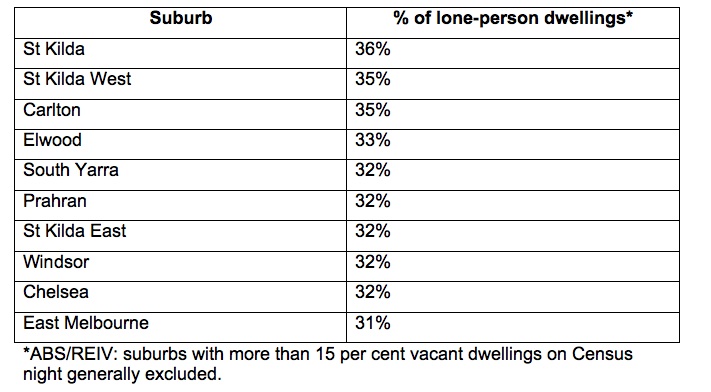
Inner Melbourne’s bayside is the hotspot for a single person, according to the Real Estate Institute of Victoria’s (REIV) analysis of the 2011 Australian Bureau of Statistics Census.
Bayside suburbs of St Kilda, St
Kilda West, Carlton, Elwood and South Yarra have the highest proportion of
single person households in Melbourne, along with Carlton in Melbourne’s inner
north, reports REIV policy and public affairs manager Robert Larocca.
These trends play an enormous
role in determining development and demand for housing, says Larocca.
“In St Kilda, St Kilda West,
Carlton, Elwood and South Yarra, at least one in three homes have only one
resident. New developments clearly respond to this demographic trend by building
residences more suited to single people.”
The data also demonstrates that
the further the suburb is from the CBD, the less likely it is that only one
person will be residing in the home, says Larocca.
“There is one interesting
exception – the Belgrave/Lilydale train line, where most suburbs have a higher
than average proportion of lone-resident households.
“At the other end of the
spectrum are the growth suburbs: Point Cook, Greenvale, Roxburgh Park, Doreen,
Narre Warren South and Narre Warren North, for instance. In those suburbs less
than 10 per cent of homes only have one resident.”
Growing families are the driving
force behind these growth areas, says Larocca.
Fixed rates at lowest level in three years

Fixed rates at lowest level in three years
Posted on Thursday, August 23 2012 at 4:31 PM
Competition between lenders for a slice of the fixed home loan market continues to heat up, with new research showing rates are at their lowest point since the global financial crisis (GFC).
An analysis by financial comparison firm
RateCity found 46 different lenders have dropped their three-year fixed loan
rates since July – including the big four banks.
The average reduction was nine basis points
but several slashed their fixed rates by between 30 and 40 basis points.
Michelle Hutchison from RateCity says some
fixed loans are becoming pretty hard to resist.
“Three-year fixed home loans, which is the
most popular term among borrowers, currently average 5.95 per cent,” Hutchison
says.
There are other deals as low as 5.5 per
cent, she says.
“We haven’t seen three-year fixed rates
this low in more than three years, when we were hit by the GFC.”
While variable home loans are still the
popular choice among borrowers, she expects the take-up of fixed rates to
increased over the coming year.
“(There’s) uncertainty about which
direction official rates will move, (so) we expect to see more borrowers taking
up fixed home loans.”
According to the Australian Bureau of
Statistics, fixed home loans finance in June accounted for just over 10 per
cent of all mortgages. That represents an increase from 6.9 per cent in the
same period last year.
Follow us on Twitter.
Was this article helpful? Place a link to it from your website, or share it using the button below.

Recent articles:
Fixed rates at lowest level in three years
The factors affecting Canberra’s apartment market
Private sales on the rise
Call for crackdown on illegal parking in unit complexes
Major expansion of Bowen Basin gas project
Calls for easements to be compulsory in Queensland
Leave a comment
Comments
Article source: http://feedproxy.google.com/~r/API_Property_News/~3/9WasgGSr6KY/fixed-rates-at-lowest-level-in-three-years